
What happens when the war ends?
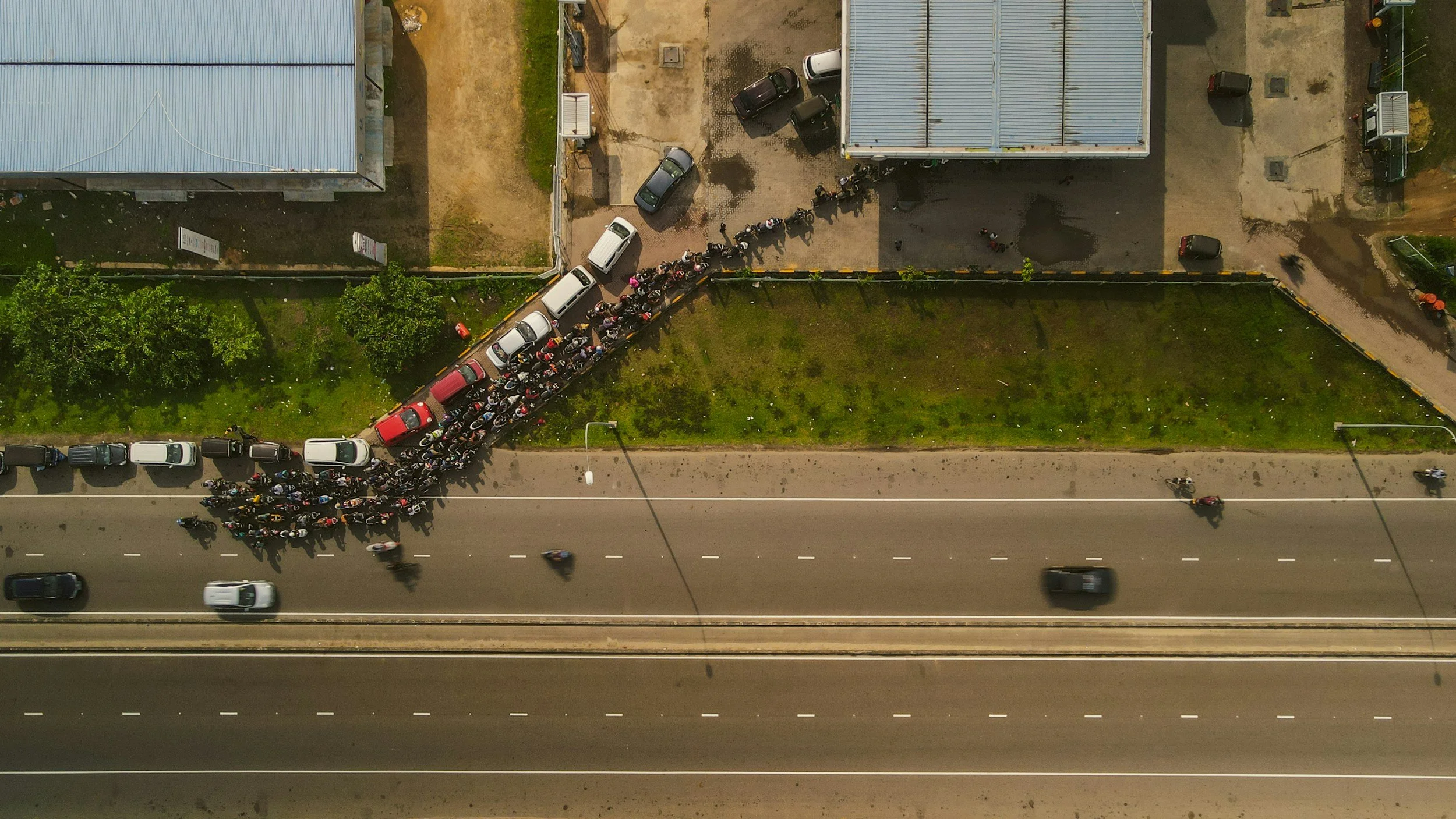
Long lines at a petrol station.
When the war in the Middle East eventually subsides, governments will declare stability restored, markets will settle, and attention will shift elsewhere.
But for families already stretched by rising costs, the question shouldn’t be whether prices come down in the short term. It should be – what stops this all from happening over again?
Because this crisis is not an anomaly, but an inherent feature of the system.
Right now families all over the world are paying more for fuel, transport, and everyday necessities because of a conflict taking place thousands of kilometres away. This is not bad luck. It’s what happens when you are on the wrong end of a long, fragile, global fossil fuel supply chain, where shocks like wars, political tensions, and blockades quickly translate into higher prices at the petrol bowser and the checkout.
No one should be paying for a war they didn’t start. Especially not while oil and gas companies profit from the instability driving up households’ costs.
The Albanese Government has taken steps to try and ease some of the immediate pressures. Temporarily halving the fuel excise, reducing the heavy vehicle user road charge, and underwriting fuel purchases by private operators can provide some short term relief. But let’s not kid ourselves: they are band-aid measures at best. They won’t do anything to fix the underlying problems but hopefully can soften the blow for families already doing it tough.
And the underlying problem is this: oil and gas are inherently volatile, globally-traded commodities, deeply entangled with geopolitical conflict. For as long as we depend on them, we will be at the mercy of a plethora of potential crises we cannot control.
We’ve seen this happen before. Russia’s invasion of Ukraine sent energy prices soaring around the world. Earlier supply disruptions have done the same. It’s the same pattern over and over – global shock, prices spike, the public pays while polluters profit.
And just as reliably, each time politicians respond with temporary relief rather than structural change.
There are signs of a better approach this time. The federal government’s $25 million investment, through the Australian Renewable Energy Agency (ARENA), to support fast charging infrastructure for electric trucks is a step in the right direction. Electrifying transport, especially heavy transport, is exactly the kind of structural shift that can reduce vulnerability to external oil shocks.
But in terms of timing, this announcement will do nothing to alleviate the current crisis.
Instead, if a program like this had been rolled out years ago, the impact of today’s price shock would be smaller. If such programs had been implemented in every state, just in the years since the Russian invasion of Ukraine, the difference today would be substantial. More of the economy would already be insulated. More households and businesses would be less exposed. And the government would probably save millions on the diesel fuel rebate too.
The lesson is that further delaying this vital work will cost us later on.
Calls to drill for more oil in Australia inevitably follow such crises. They are reflexive and ill-considered at best. New oil projects take years, often decades, to come online. They cost billions. They come with environmental damage and pollution. And crucially, much of that oil would still be sold into global markets, not reserved for domestic use. That means Australian communities would remain exposed to the same global price volatility.
In short, drilling will deepen the crisis rather than resolve it.
The hard truth is that the fossil fuel system always has another shock in store. Another conflict. Another disruption. Another price spike that hits households with no warning.
So when the war ends, the real test isn’t whether prices ease. It’s whether we’ve learned anything.
Do we continue papering over the cracks of the system, hoping the next crisis is less severe? Or do we start reducing our exposure altogether?
That means accelerating the electrification of transport, building out renewable energy at scale, and investing in infrastructure that makes households and businesses less dependent on a power source, whose price is set by foreign wars.
Most of all, it means recognising that this is an issue that goes beyond climate. Reducing dependence on oil and gas is a security issue, a cost of living issue, and a fairness issue. As long as we remain a part of the system, the outcomes will remain the same.
Families will pay more. Companies will profit. And the next crisis is always just around the corner.